Last updated: 13 October 2026
In short: since 1 October 2026, Swiss companies limited by shares (AG/SA), limited liability companies (GmbH/Sàrl), cooperatives and other legal entities must report their beneficial owners to the federal transparency register. A beneficial owner is anyone who directly or indirectly holds at least 25 % of the capital or voting rights, or who controls the company in another way. Reporting is free of charge via EasyGov. For existing companies the deadlines are staggered until 31 March 2027, in one case until 30 September 2028; any change in the commercial register shortens the deadline to one month.
Key facts
- Legal basis: Federal Act on the Transparency of Legal Entities (TJPG, SR 955.3) and its ordinance (TJPV), in force since 1 October 2026.
- Who reports: AG/SA, partnership limited by shares, GmbH/Sàrl, cooperative, SICAV, SICAF, limited partnership for collective investment, and foreign legal entities with a Swiss connection.
- Threshold: at least 25 % of the capital or votes, directly or indirectly, alone or in concert; otherwise control in another way.
- Reporting: electronically via EasyGov with an AGOV login; registration, changes and deletion are free of charge.
- Deadlines: staggered by legal form and audit regime until 31 March 2027; new companies and changes within one month.
- Sanctions: fines of up to CHF 500,000 for intentional breaches of the reporting duty.
Contents: What are the TJPG and the transparency register? · Who has to report? · Who counts as a beneficial owner? · What information is reported · By when must you report? · How reporting works on EasyGov · What happens if a company does not report? · What fiduciaries should do now · What to do now: four steps
What are the TJPG and the transparency register?
The Federal Act on the Transparency of Legal Entities and the Identification of Beneficial Owners (TJPG) creates a central, non-public register of beneficial owners. It is kept by the Federal Office of Justice; supervision lies with a control body attached to the Federal Department of Finance. Only authorities, financial intermediaries and advisers may access it, and only to fulfil their legal duties. Neither the public nor business partners can consult the register.
The aim is to identify unambiguously the natural persons at the end of every ownership or control chain, making money laundering, terrorist financing and sanctions evasion harder. Parliament adopted the Act on 26 September 2025; the Federal Council brought it into force together with the ordinance on 1 October 2026.
The duty to know one’s beneficial owners is not new: shareholders and members already had to report them to the company under Art. 697j and 790a of the Code of Obligations. What is new is that the company verifies and documents this information and reports it to a state register. How share register, commercial register and transparency register fit together is explained in Share register, commercial register and transparency register: what is the difference?
Who has to report?
Under Art. 2 TJPG, the following entities must report:
| Legal entity | Reporting duty |
|---|---|
| Company limited by shares (AG/SA), partnership limited by shares | Yes |
| Limited liability company (GmbH/Sàrl) | Yes |
| Cooperative | Yes |
| SICAV, SICAF, limited partnership for collective investment | Yes |
| Foreign legal entity with a Swiss branch entered in the commercial register, with its effective management in Switzerland, or owning real estate in Switzerland | Yes |
| Trustees domiciled or established in Switzerland, or administering trusts in Switzerland | Yes, for the trusts |
| Sole proprietorship, general and limited partnership, association, foundation | No (not listed in Art. 2 TJPG) |
| Listed companies and subsidiaries held more than 75 % by listed companies; pension institutions; legal entities held at least 75 % by public bodies | No (exemption under Art. 3 TJPG) |
A foundation or an association can nevertheless be part of the control chain of a reporting company. In that case, the special rules under Art. 7 or 8 TJPV apply, and the company must identify the persons behind it.
Who counts as a beneficial owner?
Under Art. 4 TJPG, a beneficial owner is any natural person who ultimately controls the company because they hold, directly or indirectly, alone or in concert with third parties, at least 25 % of the capital or votes, or because they control the company in another way. If nobody meets these criteria, the most senior member of the management body is deemed the beneficial owner as a fallback, usually the natural person who chairs the executive management or holds the chair of the board of directors.
The ordinance specifies the three routes to control:
- Direct holding (Art. 1 TJPV): at least 25 % of the capital or voting rights without an intermediary. Voting rights count even if the capital share is smaller, for example with voting shares.
- Indirect holding (Art. 2 TJPV): the person holds more than 50 % of one or more intermediate entities, which in turn directly or indirectly hold at least 25 % of the company. Shares are not multiplied; what matters is the majority at each level. Examples are in Control chains: identifying beneficial owners in holding, family and fiduciary structures.
- Control in another way (Art. 3 TJPV): the right or the actual ability to appoint or remove more than half of the board or management, to block key decisions (purpose, strategy, budget, financing) or to force distributions, for example through shareholders’ agreements, conversion or option rights, provisions in the articles or fiduciary arrangements.
Anyone who coordinates their conduct with third parties to exercise control jointly is acting in concert (Art. 4 TJPV); the holdings are then added together. The calculation rule is explained in The 25 % threshold and beneficial owners, the basic concept in Beneficial owners simply explained.
What information is reported
For each beneficial owner, the company reports the following information under Art. 9 TJPG and Art. 10–21 TJPV:
- surname and first names, date of birth, nationalities, municipality of residence with postcode and country of residence; the company checks whether an AHV number exists, otherwise it requests a copy of an identity document;
- the type of control: alone or jointly, direct or indirect, through a holding or in another way;
- the size of the holding in brackets: 25 to 50 %, more than 50 to 75 %, more than 75 %;
- the control chain with name, legal form, seat and UID of the intermediate entities where at least two intermediate levels, a trust or a fiduciary relationship are involved;
- if the company is held 25 to 75 % by a listed company, only that company’s details and the stock exchange.
The company must verify the identity and the status as beneficial owner (Art. 7 TJPG) and keep the supporting documents for ten years after the person ceases to be a beneficial owner (Art. 8 TJPG). If identification fails, it reports this with the available information and the steps taken (Art. 9 para. 3 TJPG). Which data and processes you need is shown in Preparing for the transparency register: data, processes and responsibilities.
By when must you report?
For companies already entered in the commercial register on 1 October 2026, the transitional deadlines in Art. 51 TJPG apply. The legal form and the audit obligation are decisive:
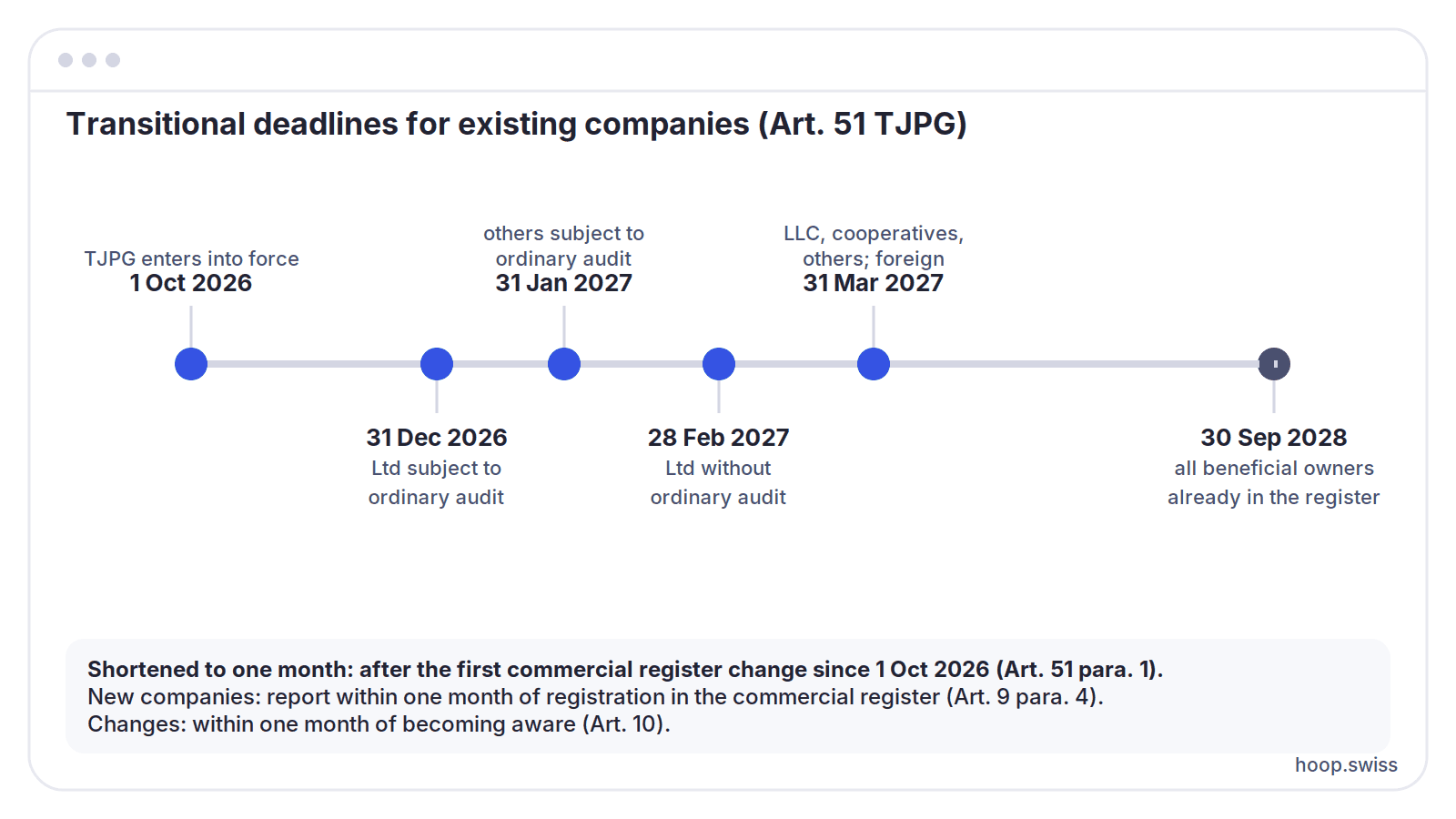
| Company | Deadline | Date |
|---|---|---|
| All beneficial owners are already entered in the commercial register as members or officers (typically: GmbH with natural persons as members, single-shareholder AG) | 2 years | 30 September 2028 |
| AG subject to an ordinary audit | 3 months | 31 December 2026 |
| Other companies subject to an ordinary audit | 4 months | 31 January 2027 |
| AG not subject to an ordinary audit | 5 months | 28 February 2027 |
| Other companies and legal entities (GmbH, cooperative without ordinary audit) | 6 months | 31 March 2027 |
| Foreign legal entities (Art. 53 TJPG) | 6 months | 31 March 2027 |
Note that the deadlines can become shorter: if a company changes anything in the commercial register after 1 October 2026, for example its address, its board or its articles, it must report within one month of that first change (Art. 51 para. 1 TJPG). The commercial register office points out the reporting duty at the first change (Art. 52 TJPG). Newly founded companies report within one month of their entry in the commercial register (Art. 9 para. 4 TJPG). Any later change, such as a change of shareholder or a beneficial owner moving house, must be reported within one month of becoming aware of it (Art. 10 TJPG).
How reporting works on EasyGov
Reports are filed electronically via the EasyGov.swiss online portal. What you need to know:
- AGOV login: the person filing needs a personal account with the Swiss government login AGOV and must confirm their identity with a passport, identity card or residence permit (Art. 29 TJPV).
- Link the company and power of attorney: the company needs a UID and is registered on EasyGov. At least one person is authorised in writing; EasyGov sends the power of attorney letter to the registered office, and persons with signing authority sign it according to the commercial register rules (Art. 27 TJPV).
- Enter the report: details of the company, of the person filing and of each beneficial owner. In the simplified procedure, EasyGov takes the data directly from the commercial register: available for a GmbH whose members are all natural persons exercising control through the capital, and for a single-shareholder AG whose sole shareholder is also the sole board member (Art. 35 and 36 TJPV).
- Confirmation: after registration you receive a confirmation. Registration, changes and deletion are free of charge; only reminders, rulings and register extracts are subject to fees.
Alternatively, a company can file the report with the cantonal commercial register office if all beneficial owners are already entered there as members or officers (Art. 11 TJPG). The office forwards the information to the transparency register without checking it.
The most senior member of the management body is responsible for the report. They may delegate the task to other persons in the company or to third parties, for example a fiduciary, but remain responsible (Art. 12 TJPG).
What happens if a company does not report?
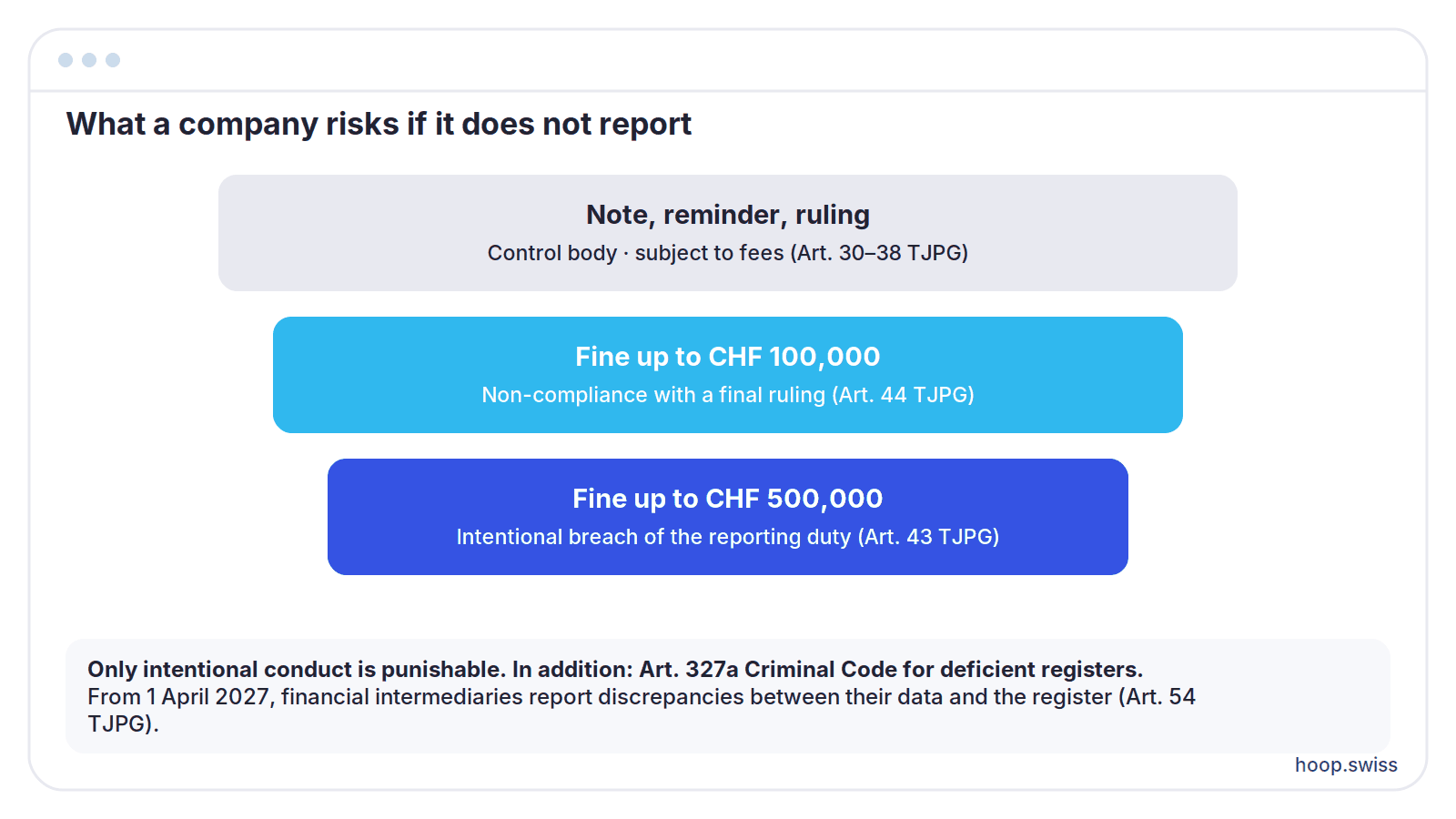
The Act provides three levels:
- Note and measures by the control body: financial intermediaries, authorities and the legal entities themselves report discrepancies between the register and reality. The control body investigates, adds a note in the register, requests a correction and can issue rulings (Art. 30–38 TJPG). Reminders and rulings are subject to fees (Art. 41 TJPG).
- Fine of up to CHF 100,000 (Art. 44 TJPG) if someone intentionally fails to comply with a legally binding ruling of the control body that expressly refers to the penalty provided for in that article.
- Fine of up to CHF 500,000 for anyone who intentionally breaches the reporting duty towards the company, the transparency register or the commercial register, or gives false information to the control body (Art. 43 TJPG).
Only intentional conduct is punishable. Anyone who misses the deadlines, however, first faces reminders and rulings with fees, plus questions from banks: from April 2027, financial intermediaries must report discrepancies between their client data and the register (Art. 54 TJPG).
What fiduciaries should do now
Anyone looking after several mandates usually reports as an authorised third party. Authorisation is granted separately per company, i.e. per UID. The following approach has proven useful:
- Mandate inventory: record the legal form, audit regime and deadline for each mandate. Mandates with commercial register changes since 1 October 2026, or with planned changes, have only one month.
- Clarify the structure: update the share or members’ register, draw the chains of holdings, record shareholders’ agreements and fiduciary relationships, determine the beneficial owners per mandate.
- Collect evidence: identity document copies or AHV numbers, residence details, evidence of control; documentation duty under Art. 8 TJPG.
- Set up EasyGov: AGOV account, powers of attorney per mandate, access rights in user management.
- Monitor deadlines: every later change triggers a new one-month deadline; a digital share register with version history makes the evidence easy.
What to do now: four steps
- Determine the deadline: check the legal form and audit obligation, note the date from the table above; allow for the one-month deadline if commercial register changes are planned.
- Identify the beneficial owners: update the share or members’ register, trace the control chains, consider voting rights and contracts; ask shareholders and members to report under Art. 13 TJPG.
- Verify and document: evidence identity and control, file the documents, assign responsibility within the company.
- Report: set up the AGOV account and EasyGov authorisation, enter the report, file the confirmation; in future, update changes within one month.
Frequently asked questions about the transparency register
Does reporting to the transparency register cost anything?
No. Registration, changes and deletion are free of charge. Fees apply only to reminders, demands, rulings and register extracts. Private providers may only charge for their own service, such as keeping the share register or preparing the report.
Does a GmbH with two members have to report?
Yes. Every GmbH is subject to the reporting duty. If both members are natural persons who hold their shares themselves and are entered in the commercial register, the GmbH can use the simplified procedure and has until 30 September 2028, provided it makes no commercial register change before then.
What applies to a single-shareholder AG?
If the sole shareholder is a natural person who is also the sole board member and the sole beneficial owner, the AG can use the simplified procedure. Because the person is entered in the commercial register as an officer, the two-year deadline until 30 September 2028 usually applies.
What happens if nobody reaches 25 %?
Then the most senior member of the management body is deemed the beneficial owner as a fallback and is reported with their function: the CEO, otherwise the chair of the board.
Does a holding via a holding company count?
Yes, if the person holds more than 50 % of the holding company and the holding company holds at least 25 % of the company. Shares are not multiplied; anyone holding only 50 % of a holding company does not control it within the meaning of the ordinance.
Who can consult the transparency register?
Only the control body, the authorities named in the Act, and financial intermediaries and advisers under the Anti-Money Laundering Act to fulfil their duties. The register is not public; companies can order an extract of their own data.
Does the transparency register replace the share register?
No. The share or members’ register remains mandatory under the Code of Obligations and is the basis for the report. The previous list of beneficial owners under Art. 697l of the Swiss Code of Obligations must be retained for ten years under Art. 50 TJPG.
Can the fiduciary take over the reporting?
Yes. The most senior member of the management body can delegate the task to third parties (Art. 12 TJPG). The third party is authorised on EasyGov per company; responsibility remains with the company.
Sources
- TJPG, SR 955.3 (Fedlex, German)
- Ordinance TJPV, AS 2026 364 (Fedlex, German)
- Federal Office of Justice: Swiss transparency register
- Transparency register: questions and answers (German)
- Transparency register: collection of examples for determining beneficial owners (PDF, German)
- EasyGov: transparency register
- Federal Council: entry into force and explanatory report on the ordinance (German)
Change log
- 13 October 2026: First version after entry into force; deadlines and procedure according to the TJPG, TJPV and information from the Federal Office of Justice.
Next steps with Hoop
Keep your share or members’ register digitally, identify the beneficial owners with their control chain and prepare the report to the transparency register directly from the register.
Digital share register · Transparency register with Hoop · What a register costs
This blog article does not constitute legal advice, it is made available “as is” and makes no claim to completeness or accuracy. Hoop makes no warranty or liability as to its content. This is excluded to the extent permitted by law. Use is at your own risk. Legal advice is recommended if necessary.